

Empowering teachers to develop their careers by giving them informed choices
Background
The Department for Education (DfE) launched the service ‘Get teacher continuous professional development’ into public beta. The vision of the service is to empower teachers to develop their careers by giving them informed choices, funding their training and tracking their progression through professional development.
This refers to any activity, formal or informal, that helps teachers to develop their skills and knowledge, and enhances their professional practice for example, a maths teacher studying for a qualification or accreditation.
The department focused on delivering two types of professional development:
- Early Career Framework (ECF) a 2 year induction for all new teachers
- National Professional Qualifications (NPQ) – qualifications that teachers take when they become leaders, for example, headteachers and deputy heads.
Role
Interaction, Visual design, Prototyping, Testing & facilitation
Contract – Farsight Consulting
I worked alongside a content designer and user researcher. Together we formed the design team. Additionally I worked in a multi-disciplinary team consisting of product managers/owners, developers, testers, architects, business analysts and other subject matter experts.

The over arching problem
The previous induction programme for new teachers in England is inconsistent, and not necessarily based on the most recent evidence and research. New teachers’ experiences vary, with many not feeling supported enough in the early stages of their career, which affects retention.
The Early Career Framework (ECF) will provide a 2-year structured induction programme for newly qualified teachers providing high quality-induction materials and greater support through a funded mentoring scheme.

Streams of work
There was a program of work which was split into various teams focused on different parts of the experience.
I worked on:
Managing professional development contracts team:
This is part of project was focused on allowing DfE and 3rd party organisations such as training providers and delivery partners to manage data relating to the contractual delivery of professional development (ECF & NPQ). This was a fundamental part of the program in order to ensure the organisations were paid in order to provide the professional development for teachers and mentors.
The exploratory team:
This part of the project was focused on exploring professional development for teachers through a non-policy lens. The aim was to understand what professional development means to teachers.

Managing professional development contracts team
Vision
Enabling the DfE and 3rd party organisations to manage supply and demand of professional development funding & contractual data. This involves DfE and 3rd party organisations efficiently moving around money and data, so the organisations get funding, teachers get trained and DfE users can spend more time on value adds like evaluation and support rather than compliance & assurance.

Research
The methodologies included contextual interviews and surveys which involved various users. This had been conducted by the teams researcher. I attended several sessions to observe, take notes and forward any questions that would aid in designing. The research helped us to understand what are the users pain points, their needs and gain deep understanding of their experience.
Users:
- Lead providers – Targeted to recruit participants to do their Full Induction course by signing up schools
- Delivery partners – Delivering training to teachers taking professional development
- DfE commercial – To manage the contract with the providers and ensure payments are made and assured
Findings
Journey map – lead providers and DFE commercial


Lead providers:
| User needs | Pain poins |
Understand the amount that I can expect to be paid | They don’t have enough view of what is upcoming |
| Understand the amount that I won’t be paid and why | Users don’t have a good view of DfE timelines |
| Compare amount due to my records to ensure they match | API documentation is out of date |
| Explore where a mismatch is if they don’t this can lead to confusion | API release notes are not detailed enough |
| Keep records for audit purposes | Lots of data passed around in spreadsheets which go out of date |
| Provide amount due to my finance team | Theres not having enough notice of API changes |
| Provide amount due to my finance team and generate invoices | Find the API technical |
DfE commercial:
| User needs | Pain poins |
| Information visible in one place | A lot of manual work |
| See amount due to providers | Relying on large spreadsheets to view information |
| Relay amount to provider match | Current app is not being used |
| Answer provider queries | Information on the current payment breakdown is hard to navigate |
| Perform assurance activities | Information is hidden behind accordians |
| See contract level information such as course and schedule | Spreadsheets can go out of date |
Delivery partners:
Journey map:

| User needs | Pain poins |
| To have view-only access to DfE data | Data duplication which causes massive overheads |
| Presentation of DfE data | School users inputting data into multiple place |
| Editing DfE data to fix mismatches | Users being charged with solving issues with data held by providers and DfE |
| Clearer guidance for schools and DPs | This task is proving very difficult without direct access to DfE data |
| Being able to see participants and their funding status | The lack of a ‘single source of truth |
| Free up time to concentrate on delivering training | Lack of understanding of the full registration journey |
Workshop – prioritising problems, defining scope of work
As a team we used the insights from research, our data analysts and support users. This helped us to shape a roadmap for the product and plan out iterations.
The UCD, products and engineering team concluded for:
- Lead providers and DfE commercial – we would prioritise a way for users to see contractual and financial information
- Delivery partners – we would provide users with a read only view of the data regarding schools and training participants.


Key outcomes:
- Supply-side improvements so the organisations involved can make (time/cost) savings to pass onto training
- Supply-side expansion by integrating delivery partner data sets to reduce data duplication
- Demand-side improvements so DfE staff reduce manual tasks to focus on delivery
- Surface options to expand Teacher CPD data beyond contracts and into policy evaluation / improvement
- Ensuring that the products meet Data and Security standards to ensure confidence in the system and data
Prototyping the solution
Based on the findings outlined previously I began work on potential solutions and created hi fidelity prototypes.
Lead providers and DfE commercial:
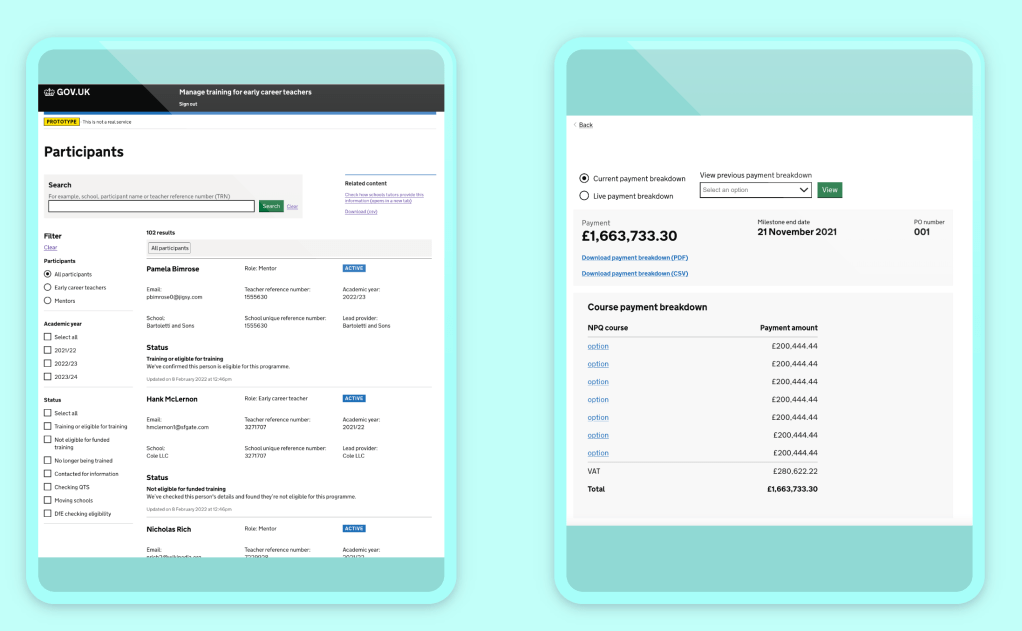
- a concept of a financial statement
- allow users to see all contractual and financial information in a single view
- allowed users to switch between financial statements depending on the time of year
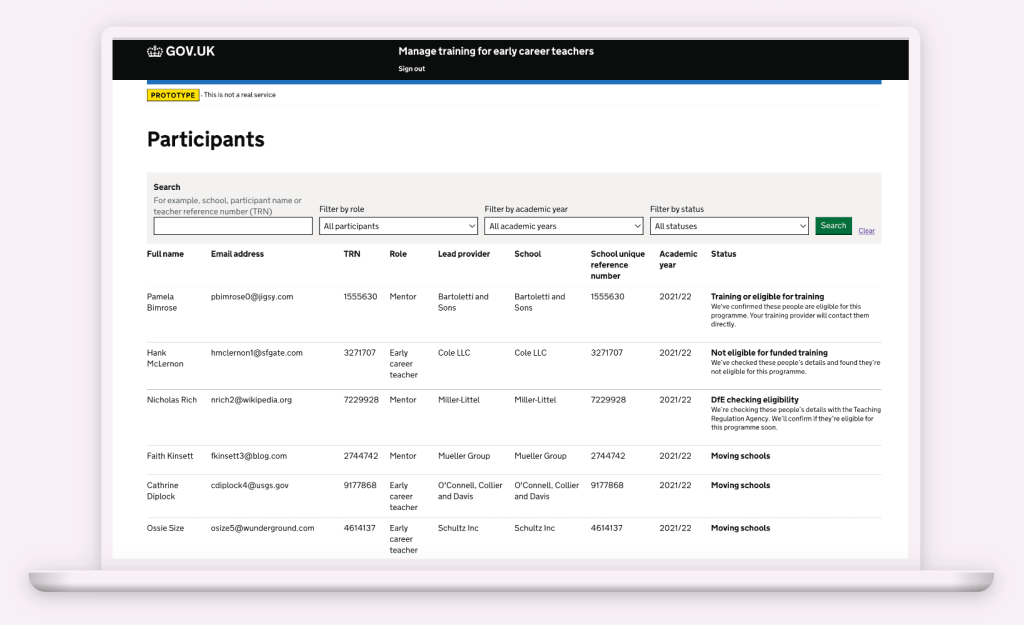
- Enabling users to see participant information to track funding eligibility
- Give DfE users the ability to see this information for all providers
- Share a consistent view with providers so both sets of users


Delivery partners
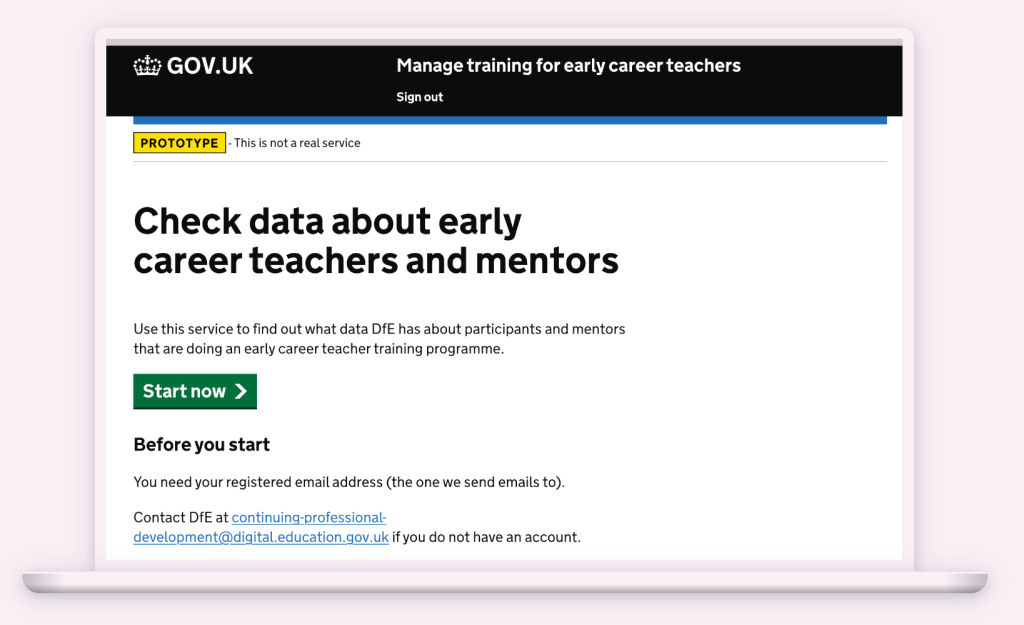
A way for users to see what data the DfE holds regarding schools and participants
Usability testing
Several rounds of usability testing were conducting to see what was working and what wasn’t. Users were set tasks to complete checking information relating to payments and navigating the system.
In the sessions I observed how users interacted with the product. This revealed that users found it easier to understand the financial information in a statement view as this told them the story of a provider contract. It enabled the providers to see this information easier than trying to get this from the API which they found technically difficult.

Iterations
Throughout the rounds of research the designs went through several iterations:
Conclusion
Since the implementation of the financial statements we’ve seen an update in the use of this and a move away from the spreadsheet heavy versions.
I received positive feedback from the program and users for simplifying such a technical part of the project allowing users to see financial information in one place.
The user feedback has been very positive with the program members saying the designs had quite the impact.
The exploratory team
Vision
The way teachers and leaders understand professional development and career progression is an unknown for the DfE. The teams vision was to surface actionable opportunities of all sizes to enable more teachers to benefit from professional development that is right for them.
Ways of working
Short (2-3 week) ‘bursts’
Tightly-scoped problems
Continual context building
Building on what’s known
Delivering where we’re best placed to do so
What the team had already done
- Assigned and reviewed research documents for each team member to read
- highlighted relevant insight and copied onto post-its
- Summarised findings into problem areas
- Sorted findings into initial buckets like ‘barriers and enablers’, ‘metrics’ and ‘policy’
- sorted further until themes emerged from the data
- We arranged themes onto a sequence from discovering opportunities to applying for CPD
- Agreed a starting point for the first ‘burst’
Joining the team
The team had made a lot progress before I joined and at this point the initial product designed was launched called Professional development for teachers and leaders. I joined the team when they arrived into their 3rd burst and started to look at how information about professional development reaches classroom teachers.
The team had lacked input from an interaction/service design perspective so I joined the team to support this need.
Packaging what we’e learnt so that others can act on it

Defining the problem
Information about DfE professional development options is not reaching all the teachers who could benefit from it, because:
- policies and offerings are new and not historically offered by the DfE
- DfE relies on third parties (providers and delivery partners) and word-of-mouth to get information out
- as a result there’s a lag in understanding, and inequity.
Roadmap of work
The team created a road map outlining what would feature in each burst.

Research
The research was organised by our teams researcher, I observed the sessions, contributed to the analysis.
Goals:
- Understand how schools choose CPD
- What is the role of school-level users in choosing a provider
- To what extent does the prototype meet the needs of school-level users
We spoke to 4 participants with CPD coordination responsibilities:
- 2 were assistant head teachers
- 2 were deputy head teachers
Equality and diversity:
- 2 mixed or multiple ethnic groups
- 2 white

Prototype
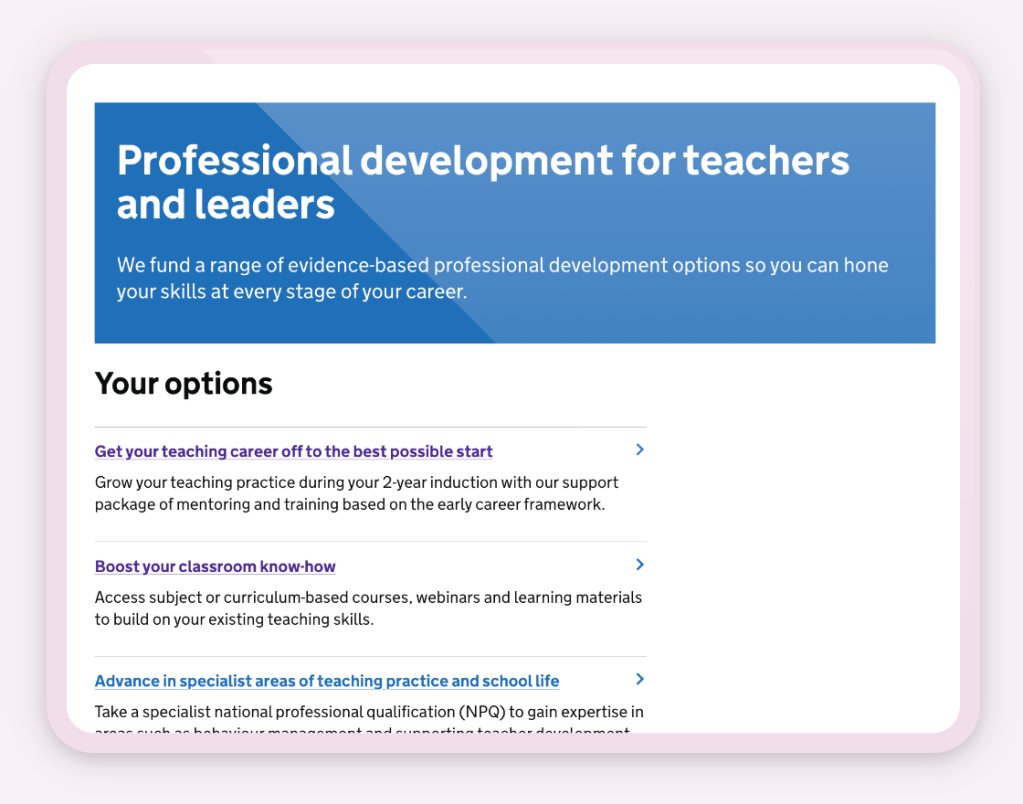
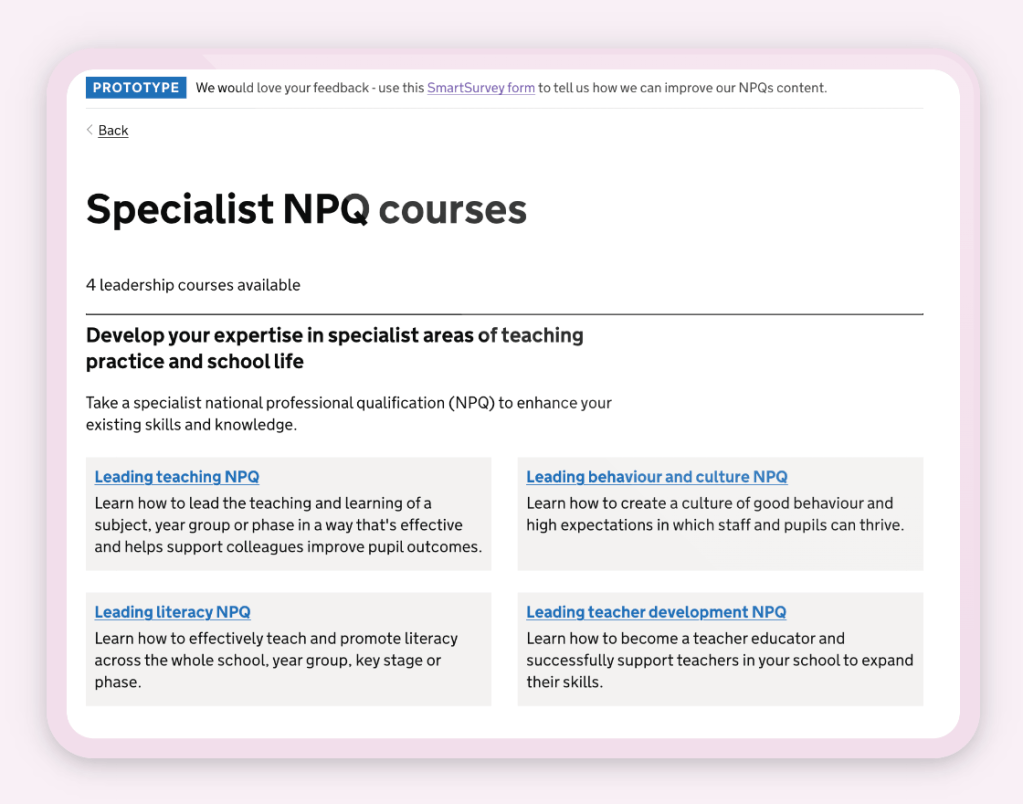
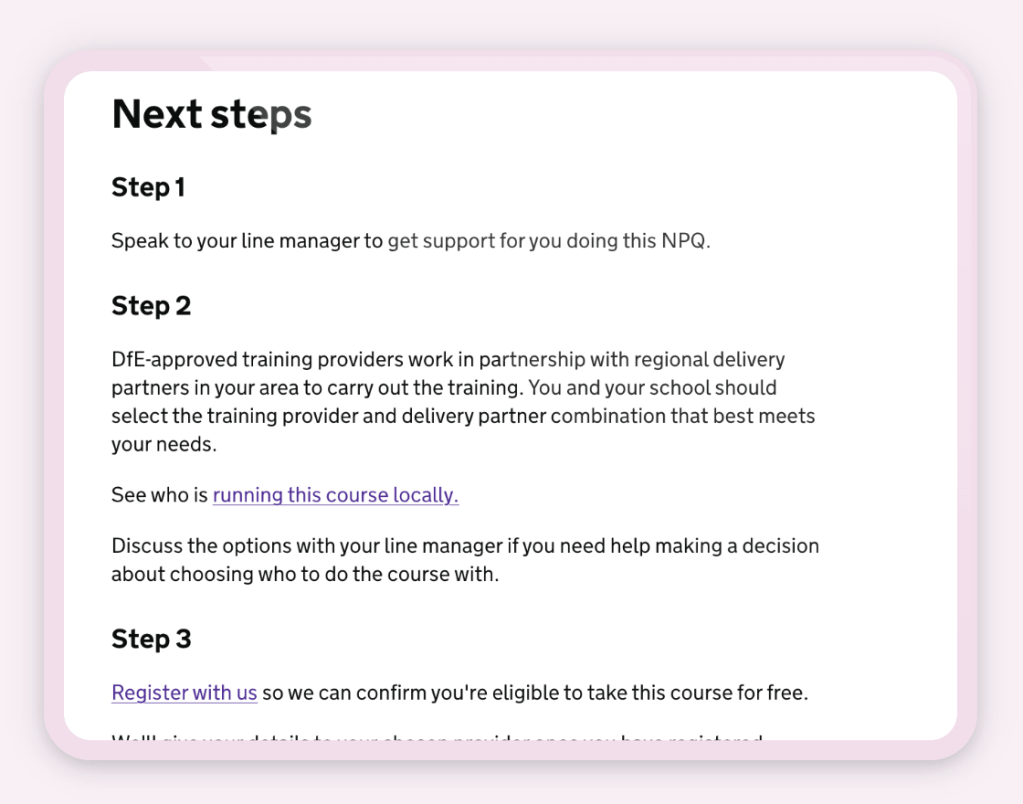
I had set-up a prototype to test our hypothesis:
- By framing the types of professional development users will find this more relatable
- It will reduce some of the burden on users
- Giving users a choice of professional development if meaningful
- The content of the courses resonates with users
What we learned
How schools choose CPD
In schools teacher professional development followed a plan devised by coordinators that was staff centred.

The role of schools in choosing an organisation appointed by the DfE
Schools needed to understand who delivered courses in their area, for example ‘who is my local teaching school hub’? Schools might have a lead provider preference e.g. preferring a lead provider who also delivered their training. Teaching school hubs may change lead providers without a school’s involvement.

To what extent does the prototype meet the needs of school-level users?
Coordinators were an audience highly aware of professional development opportunities with different needs to teachers. They expected DfE professional development to be presented by policy area (ECF, NPQ, behaviour hubs etc.). Seeing career-path-focused categories hindered their navigation through the prototype. An area of particular confusion was splitting up NPQs into 2 categories. The NPQ detail pages were well-structured and useful.

Reflection
Working with this team was great, I got to experience discovery on something that wasn’t purely driven by policy. There is a real appetite to help the DfE better understand what teachers really understand about professional development beyond these policies and what opportunities that might bring to light.
Our teams product owner would often say “The demand side – how teachers and leaders themselves perceive CPD and career progression – is a blind spot for DfE”
This resonated with me and made me think about how I could enable and help the team with this ambition. I helped the team by setting up a prototype of the service so that we could use that to test our ideas and design provocations. I shared different mockups of designs to see what would work and support the research.
Future ideas to explore
Whilst working with the team I thought a lot about how much information is out there for our teachers. The DfE Get into teaching website offers information on everything to do with teacher training, from steps to becoming a teacher, to fees and funding.
So I also prepared a few ideas the team could use for future exploration and design provocations:
Get into teaching adding a section for career development:

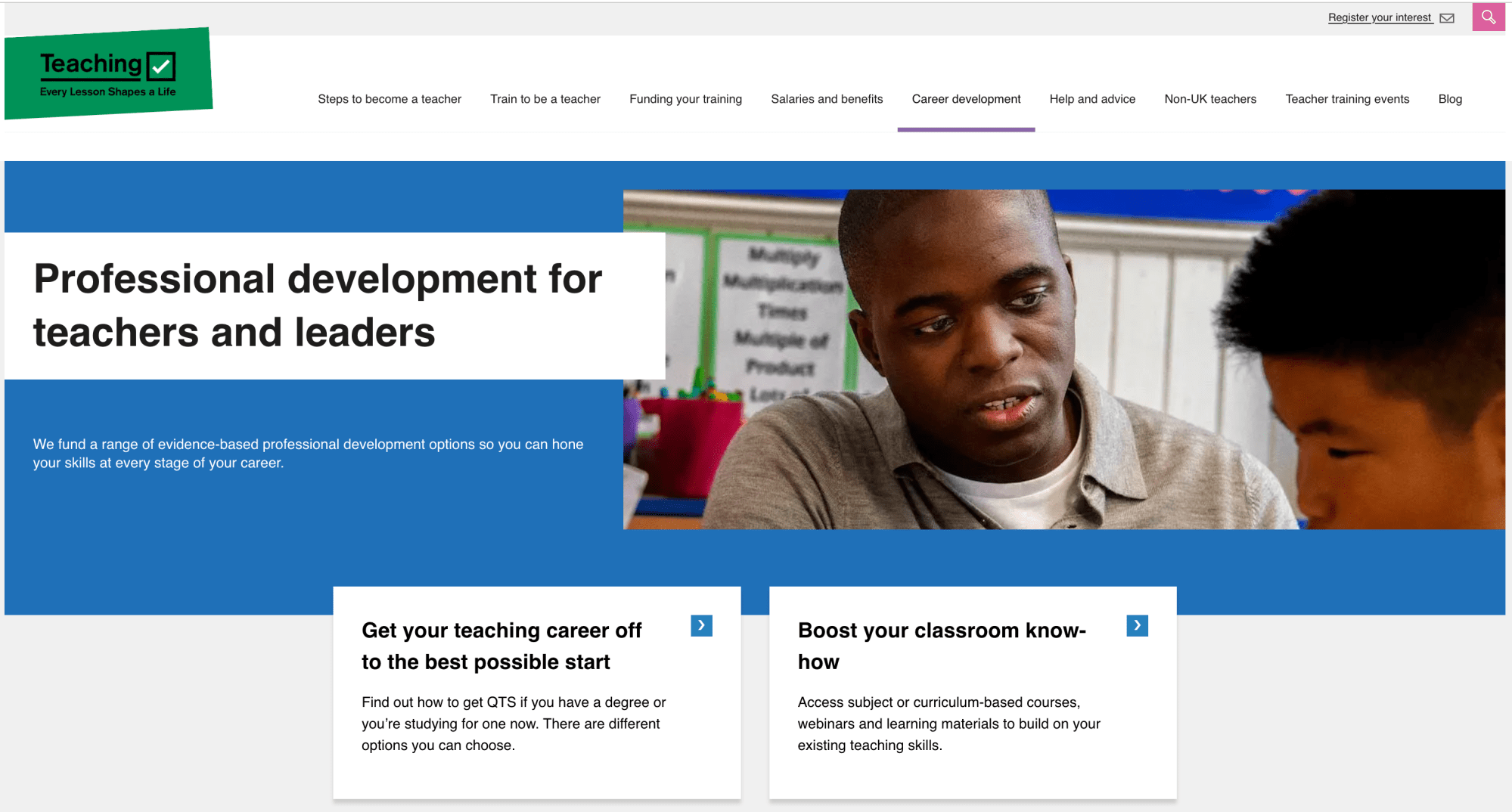
Allowing teachers and school users to search through a catalogue of professional development with the ability to filter it based on their needs.

Let’s work together to create something unique! 👨🏻🎨
Get in touch to discuss opportunities
© Zabe Aziz design 2022
 zabeaziz.com